Few English writers have given me more intellectual reading pleasure in the past decades than Ian McEwan, so it was with great anticipation that I started reading his latest, What We Can Know, when it finally became available in the Netherlands in the original English – annoyingly weeks after its Dutch translation – only to be disappointed by what I perceived as its forced structure and bloodless intellectualism. But the book did yield some bounty by way of a crucial element in the story, namely the corona that one of its main characters, elderly poet Francis Blundy, writes for and dedicates to his wife, with the title “A Corona for Vivien”.
According to Wikipedia, a corona is ‘a sequence of sonnets, usually addressed to one person, and/or concerned with a single theme. Each of the sonnets explores one aspect of the theme and is linked to the preceding and succeeding sonnets by repeating the final line of the preceding sonnet as its first line. The first line of the first sonnet is repeated as the final line of the final sonnet, thereby bringing the sequence to a close.’ As if this doesn’t constitute enough of a tour-de-force, in some coronas the last sonnet also consists of the first lines of all the previous sonnets, constituting a ‘sonnet redoublé’ or ‘heroic crown’, comprising fifteen sonnets.
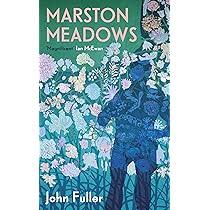
The corona that McEwan composed for his book was apparently inspired by a poem by John Fuller that ran in the Times Literary Supplement in 2021: “Marston Meadows: A Corona for Prue”, that Fuller dedicated to his wife of 65 years. This breathtakingly clever but also very moving poem is not the only one in which Fuller utilizes a technically challenging literary form. His collection ‘Marston Meadows’ contains poems with all kinds of complex and playful rhymes, anagrams, even one whose syllabic structure is based on the first fourteen digits of pi, “Winter Cadae”. It starts like this:
In winter
We
Are near freezing
In body and mind,
But the thought of cycles consoles us.
Get it, also the title? And it’s ten pages.
Besides this fun (?) aspect, however, Fuller’s deeply felt and rich poetry consists of much more than just clever stuff for nerds or puzzle enthusiasts, and it’s worth the time and effort to discover.
Here’s an interview with John Fuller.